Built from Scratch, Scaled to 500 Million
Highlights
“The precision required for signal alignment in space-mission streaming leaves no room for latency or error.”
Challenge
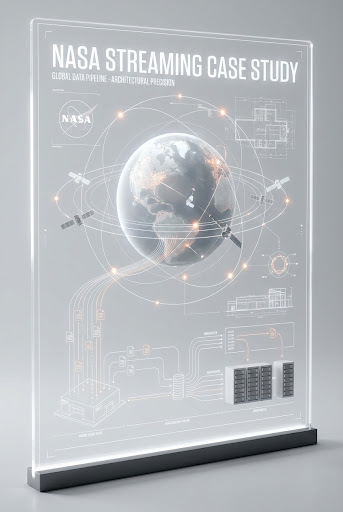
When V! Studios first built NASA’s streaming pipeline, streaming itself was not yet an established practice. Broadband was limited and uneven. There were no standard playbooks for taking a traditional broadcast satellite signal, compressing and digitizing it, routing it through a vendor’s infrastructure, and delivering it reliably to a public audience at scale. Every part of the pipeline had to be designed, sourced, and tested from first principles.
The technical challenge was compounded by NASA’s organizational structure. Streaming events originate across ten field centers, each with its own equipment, personnel, and signal characteristics. Aligning those signals into a single, consistent output required establishing protocols that could hold across a distributed organization, then maintaining them through years of personnel changes, technology upgrades, and an ever-expanding event schedule.
And the technology never stopped moving. What worked for standard definition did not work for high definition. What worked for HD did not work for UHD. Each transition required rebuilding parts of the pipeline while keeping everything else operational. NASA’s audience and its expectations grew with each generation.
Action
Infrastructure & Vendor Selection
V! Studios established NASA’s primary streaming pipeline from the ground up, working with NASA’s programming team to select and evaluate vendors capable of delivering the required speed, compression, resolution, and reliability at each stage of the technology’s evolution. The work began by converting NASA’s traditional broadcast satellite signal into a digitized, compressed format suitable for internet delivery, then building the infrastructure around that conversion to route content reliably from source to viewer.
Signal Alignment & Coordination
Signal alignment across NASA’s centers was one of the foundational challenges. V! Studios developed the protocols and coordination structures that allowed events originating at different centers to flow into a unified pipeline, regardless of the local equipment or personnel involved. That coordination function has remained a core part of V! Studios’ role throughout the engagement.
As streaming technology advanced, V! Studios managed each transition: from standard definition to HD, from HD to UHD and HDR, from early streaming infrastructure to CDN-fronted global distribution. At each stage, vendor selection, pipeline testing, and quality validation were V! Studios’ responsibility. The team did not simply inherit an existing system. It has built, rebuilt, and continuously upgraded the system across more than two decades of operation.
QA Authority & Dispatch
Today, V! Studios functions as the quality assurance authority and dispatch coordinator for NASA’s entire streaming operation. Before any event is made public, the team verifies that the output meets the required standard. When something is wrong, V! Studios identifies the issue, determines who in the pipeline is responsible for resolving it, and coordinates the fix. NASA relies on the team to know the pipeline well enough to route problems to the right people quickly.
Result
The pipeline V! Studios built has delivered 500 million cumulative viewers across NASA streaming events. At the 2024 Total Solar Eclipse, it carried 2.6 million concurrent viewers, the largest streaming audience ever recorded, larger than any Super Bowl broadcast. Our team received an Honors Award for innovative web streaming, recognizing its capability.
The system has operated continuously through every major shift in streaming technology, from the early days of broadband through the current generation of UHD and HDR delivery, without a break in service and without NASA needing to rebuild its streaming operation from scratch at each transition.
Why it matters
This engagement started before most of the industry it now operates within existed. V! Studios did not step into a functioning streaming infrastructure and optimize it. It built the infrastructure, selected the vendors, aligned the centers, established the quality standards, and then kept pace with every technology transition for more than two decades without losing the thread.
That kind of continuity is rare in federal technology work. Most engagements cycle through vendors, requiring each successive team to rebuild institutional knowledge from scratch. V! Studios has stayed because the work has compounded: each year of operational experience makes the team more capable, not just more familiar. NASA knows its streaming operation will be handled by people who have seen every failure mode, managed every technology upgrade, and maintained the same standard throughout.
The 2024 Total Solar Eclipse result, 2.6 million concurrent viewers, more than any Super Bowl had ever drawn, is the proof point. That number does not happen by accident. It is the product of a pipeline built carefully, upgraded continuously, and operated by a team that has never stopped treating quality as the only acceptable outcome.